Solving the ABA Problem in Rust with Hazard Pointers
Introduction
In our journey exploring solutions to the ABA problem in Rust, we’ve covered tagged pointers and epoch-based reclamation. In this third and final post of the series, we’ll examine hazard pointers – a technique that provides fine-grained protection for individual memory locations.
Series Overview
This is the final post in our three-part series on solving the ABA problem in Rust:
- Part 1: Tagged Pointers with Versioning – We covered how to pair pointers with version numbers
- Part 2: Epoch-Based Reclamation – We explored using epochs for safe memory reclamation
- Part 3: Hazard Pointers – Today’s post on using hazard pointers for precise memory protection
What Are Hazard Pointers?
Hazard pointers are a memory reclamation technique that protects specific memory addresses from being recycled while they’re in use. Unlike epoch-based reclamation, which protects all shared memory during an epoch, hazard pointers protect only explicitly marked locations.
Key concepts:
- Pointer Registration: Threads explicitly register pointers they’re currently using
- Per-Thread Protection: Each thread maintains its own list of hazard pointers
- Selective Reclamation: Memory is only reclaimed when no thread has registered it as hazardous
- Retirement Queue: Memory scheduled for deletion is first moved to a retirement queue
How Hazard Pointers Work
Hazard pointers work through these key mechanisms:
- Declaration: Before accessing a shared pointer, a thread publishes it as a hazard pointer
- Validation: After publishing, the thread verifies the pointer is still valid
- Access: The thread can safely access the pointer’s data
- Retirement: When memory is no longer needed, it’s queued for deletion
- Scanning: Before reclaiming memory, all threads’ hazard pointer lists are scanned
- Reclamation: Only memory not present in any hazard list is actually freed
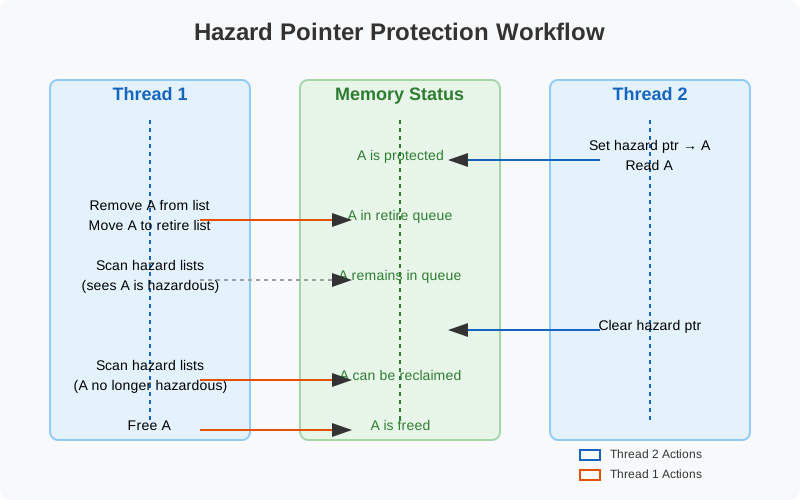
The diagram illustrates the step-by-step process of how hazard pointers work to protect memory from premature reclamation:
Thread 2 Protection Phase:
- Thread 2 sets a hazard pointer to memory location A
- Thread 2 reads from A safely
- Memory status shows A is now protected
Thread 1 Removal Phase:
- Thread 1 removes A from the primary data structure
- Thread 1 moves A to a retirement queue
- Memory status shows A is now in retirement queue, but not yet freed
First Reclamation Attempt:
- Thread 1 scans all hazard pointer lists
- Thread 1 sees A is marked as hazardous by Thread 2
- Memory status shows A remains in the retirement queue
Protection Release:
- Thread 2 finishes its work and clears its hazard pointer to A
- Memory status is updated to reflect this change
Final Reclamation:
- Thread 1 scans hazard lists again
- Thread 1 sees A is no longer hazardous
- Memory status shows A can now be reclaimed Thread 1 safely frees memory location A
Implementation in Rust
Let’s implement a lock-free stack with hazard pointers:
use std::collections::HashSet;
use std::fmt;
use std::ptr;
use std::sync::atomic::{AtomicPtr, AtomicUsize, Ordering};
use std::sync::{Arc, Mutex};
use std::thread::{self, ThreadId};
First, let’s define our HazardPointers type:
/// A thread-local hazard pointer registry
///
/// This struct maintains a list of pointers that a thread is currently using,
/// protecting them from being reclaimed by other threads.
pub struct HazardPointers<T> {
    /// Map from thread ID to list of hazard pointers
    thread_hazards: Mutex<Vec<(ThreadId, *mut T)>>,
    /// Global retirement list of nodes awaiting safe reclamation
    retire_list: Mutex<Vec<*mut T>>,
}

// Safety: HazardPointers can be safely shared between threads because
// all its mutations are protected by internal mutexes
unsafe impl<T> Send for HazardPointers<T> {}
unsafe impl<T> Sync for HazardPointers<T> {}
Now let’s implement the core functionality for managing hazard pointers:
impl<T> HazardPointers<T> {
    /// Creates a new hazard pointer registry
    pub fn new() -> Self {
        HazardPointers {
            thread_hazards: Mutex::new(Vec::new()),
            retire_list: Mutex::new(Vec::new()),
        }
    }

    /// Registers a hazard pointer for the current thread
    ///
    /// This protects the given pointer from being reclaimed by other threads
    /// until explicitly cleared with clear_hazards().
    pub fn protect(&self, ptr: *mut T) -> *mut T {
        if !ptr.is_null() {
            let thread_id = thread::current().id();
            let mut hazards = self
                .thread_hazards
                .lock()
                .expect("Failed to lock hazard list - mutex poisoned");

            // Check if we already have an entry for this thread
            for entry in hazards.iter_mut() {
                if entry.0 == thread_id {
                    entry.1 = ptr;
                    return ptr;
                }
            }

            // No existing entry, add a new one
            hazards.push((thread_id, ptr));
        }
        ptr
    }

    /// Clears all hazard pointers for the current thread
    ///
    /// This should be called when the thread no longer needs to access
    /// previously protected pointers.
    pub fn clear_hazards(&self) {
        let thread_id = thread::current().id();
        let mut hazards = self
            .thread_hazards
            .lock()
            .expect("Failed to lock hazard list - mutex poisoned");
        hazards.retain(|entry| entry.0 != thread_id);
    }
}
Next, we implement memory retirement and reclamation:
    /// Adds a pointer to the retirement list for later reclamation
    ///
    /// The memory will be reclaimed when it's safe to do so (i.e., when no thread
    /// has it marked as hazardous).
    pub fn retire(&self, ptr: *mut T) {
        if !ptr.is_null() {
            let mut retire = self
                .retire_list
                .lock()
                .expect("Failed to lock retire list - mutex poisoned");
            retire.push(ptr);

            // Attempt to reclaim memory if retire list is getting large
            if retire.len() > 10 {
                self.try_reclaim(false);
            }
        }
    }

    /// Attempts to reclaim memory from the retirement list
    ///
    /// This scans all hazard pointers across all threads and only reclaims
    /// memory that isn't protected by any thread.
    pub fn try_reclaim(&self, force: bool) -> usize {
        // Get the current set of hazardous pointers
        let hazards = self
            .thread_hazards
            .lock()
            .expect("Failed to lock hazard list - mutex poisoned");
        let hazardous: HashSet<*mut T> = hazards.iter().map(|entry| entry.1).collect();

        // Get the retirement list
        let mut retire = self
            .retire_list
            .lock()
            .expect("Failed to lock retire list - mutex poisoned");

        // If the retire list is empty or too small and we're not forcing reclamation, do nothing
        if retire.is_empty() || (!force && retire.len() <= 5) {
            return 0;
        }

        // Separate nodes that are safe to reclaim from those that are still hazardous
        let (to_free, still_hazardous): (Vec<*mut T>, Vec<*mut T>) =
            retire.drain(..).partition(|ptr| !hazardous.contains(ptr));

        // Update the retirement list with nodes that couldn't be freed yet
        *retire = still_hazardous;

        // Count how many nodes we freed
        let freed_count = to_free.len();

        // Free the safe nodes
        for ptr in to_free {
            unsafe {
                let _ = Box::from_raw(ptr);
            }
        }

        freed_count
    }
}

impl<T> Drop for HazardPointers<T> {
    fn drop(&mut self) {
        // Final reclamation attempt to free everything
        self.try_reclaim(true);

        // If there are still pointers in the retire list, that means they're
        // still protected by some thread, which is a bug (memory leak)
        let retire = self
            .retire_list
            .lock()
            .expect("Failed to lock retire list - mutex poisoned");
        if !retire.is_empty() {
            // Just log a warning in a real application you might want to panic
            eprintln!("Warning: HazardPointers dropped with {} items still in retire list. This is a memory leak.", retire.len());
        }
    }
}
Now let’s define the Node type for our lock-free stack:
/// A node in our lock-free stack
pub struct Node<T> {
    /// The value stored in this node
    pub value: T,
    /// Pointer to the next node in the stack
    pub next: *mut Node<T>,
}

impl<T: fmt::Debug> fmt::Debug for Node<T> {
    fn fmt(&self, f: &mut fmt::Formatter<'_>) -> fmt::Result {
        f.debug_struct("Node")
            .field("value", &self.value)
            .field("next", &self.next)
            .finish()
    }
}
Let’s define the actual LockFreeStack structure:
/// A lock-free stack using hazard pointers for memory reclamation
///
/// This implementation is thread-safe and prevents the ABA problem
/// through the use of hazard pointers.
pub struct LockFreeStack<T> {
    /// Atomic pointer to the head of the stack
    pub head: AtomicPtr<Node<T>>,
    /// Hazard pointer registry used to protect nodes from reclamation
    pub hazard_pointers: Arc<HazardPointers<Node<T>>>,
    /// Counter tracking the current size of the stack
    size: AtomicUsize,
    /// Whether to print debug information
    verbose: bool,
}
Now let’s implement the stack operations:
impl<T> LockFreeStack<T> {
    /// Creates a new empty stack
    pub fn new(verbose: bool) -> Self {
        LockFreeStack {
            head: AtomicPtr::new(ptr::null_mut()),
            hazard_pointers: Arc::new(HazardPointers::new()),
            size: AtomicUsize::new(0),
            verbose,
        }
    }

    /// Pushes a value onto the stack
    pub fn push(&self, value: T) -> Result<(), String> {
        // Create a new node
        let new_node = Box::into_raw(Box::new(Node {
            value,
            next: ptr::null_mut(),
        }));

        loop {
            // Get the current head with Acquire ordering
            let current_head = self.head.load(Ordering::Acquire);

            // Point our new node to the current head
            unsafe {
                (*new_node).next = current_head;
            }

            if self.verbose {
                println!(
                    "Attempting to push node: {:p} with next pointing to: {:p}",
                    new_node, current_head
                );
            }

            // Try to update the head to our new node
            match self.head.compare_exchange(
                current_head,
                new_node,
                Ordering::Release,
                Ordering::Relaxed,
            ) {
                Ok(_) => {
                    // Successfully pushed the node
                    self.size.fetch_add(1, Ordering::Relaxed);
                    if self.verbose {
                        println!("Successfully pushed node: {:p}", new_node);
                    }
                    return Ok(());
                }
                Err(actual_head) => {
                    // Failed to push, try again with the updated head
                    if self.verbose {
                        println!(
                            "Push conflict detected! Expected head: {:p}, actual head: {:p}",
                            current_head, actual_head
                        );
                    }
                    unsafe {
                        (*new_node).next = actual_head;
                    }
                }
            }
        }
    }
}
The pop operation is the most important part for ABA prevention:
    /// Pops a value from the stack
    pub fn pop(&self) -> Option<T> {
        loop {
            // Get the current head
            let current_head = self.head.load(Ordering::Acquire);
            if current_head.is_null() {
                // Stack is empty
                if self.verbose {
                    println!("Stack is empty, cannot pop");
                }
                return None;
            }

            if self.verbose {
                println!("Attempting to pop head: {:p}", current_head);
            }

            // CRITICAL STEP 1: Mark this pointer as hazardous before accessing it
            let protected_head = self.hazard_pointers.protect(current_head);

            // CRITICAL STEP 2: Check if the head has changed since we loaded it
            // This is crucial for ABA prevention - if head changed, retry
            if self.head.load(Ordering::Acquire) != current_head {
                if self.verbose {
                    println!("Head changed during protection, retrying pop");
                }
                continue;
            }

            // Now safe to access the pointer
            let next = unsafe { (*protected_head).next };

            // Try to update the head to the next node
            match self.head.compare_exchange(
                current_head,
                next,
                Ordering::Release,
                Ordering::Relaxed,
            ) {
                Ok(_) => {
                    // Successfully popped the node
                    let value = unsafe {
                        // Move out the value
                        let v = std::ptr::read(&(*protected_head).value);
                        v
                    };

                    self.size.fetch_sub(1, Ordering::Relaxed);

                    if self.verbose {
                        println!(
                            "Successfully popped head: {:p}, new head: {:p}",
                            protected_head, next
                        );
                    }

                    // Clear hazard pointer and schedule node for reclamation
                    self.hazard_pointers.clear_hazards();
                    self.hazard_pointers.retire(protected_head);

                    return Some(value);
                }
                Err(_) => {
                    // Failed to pop, retry
                    if self.verbose {
                        println!("Pop conflict detected! Head changed during CAS");
                    }
                    continue;
                }
            }
        }
    }

    /// Returns the current size of the stack
    pub fn len(&self) -> usize {
        self.size.load(Ordering::Relaxed)
    }

    /// Returns true if the stack is empty
    pub fn is_empty(&self) -> bool {
        self.len() == 0
    }
}

/// Clean up resources when the stack is dropped
impl<T> Drop for LockFreeStack<T> {
    fn drop(&mut self) {
        // Pop all elements to ensure memory is freed
        while self.pop().is_some() {}

        // Final reclamation attempt
        self.hazard_pointers.try_reclaim(true);
    }
}
Let’s demonstrate the ABA problem prevention with a simpler example:
use std::time::Duration;

fn aba_demonstration() {
    println!("\nDemonstrating ABA problem prevention with hazard pointers...");
    let stack = Arc::new(LockFreeStack::new(true));

    // Initial state: Push 1, 2, 3
    stack.push(1).expect("Push should succeed");
    stack.push(2).expect("Push should succeed");
    stack.push(3).expect("Push should succeed");
    println!("Initial stack state: [3] → [2] → [1]");

    let stack_clone1 = Arc::clone(&stack);
    let stack_clone2 = Arc::clone(&stack);

    // Thread 1: Will try to pop 3 and then get delayed
    let handle1 = thread::spawn(move || {
        println!("Thread 1: Starting operation");

        // Start the pop operation but pause in the middle
        let head = stack_clone1.head.load(Ordering::Acquire);
        stack_clone1.hazard_pointers.protect(head);

        println!("Thread 1: Protected head (value 3)");

        // Simulate delay
        thread::sleep(Duration::from_millis(200));

        // Try to complete the pop operation
        println!("Thread 1: Continuing operation after delay");
        let result = stack_clone1.pop();
        println!("Thread 1: Pop result: {:?}", result);
    });

    // Thread 2: Will perform operations while Thread 1 is sleeping
    let handle2 = thread::spawn(move || {
        thread::sleep(Duration::from_millis(50));
        println!("Thread 2: Performing operations while Thread 1 is delayed");

        // Pop 3
        let val = stack_clone2.pop().expect("Stack should have value 3");
        println!("Thread 2: Popped {}", val);

        // Pop 2
        let val = stack_clone2.pop().expect("Stack should have value 2");
        println!("Thread 2: Popped {}", val);

        // Push 3 again - this would cause ABA without hazard pointers!
        stack_clone2.push(3).expect("Push should succeed");
        println!("Thread 2: Pushed 3 back");
    });

    handle1.join().expect("Thread 1 panicked");
    handle2.join().expect("Thread 2 panicked");

    println!("\nFinal stack state:");
    while let Some(val) = stack.pop() {
        println!("Value: {}", val);
    }
}
Testing the Implementation
Here are key tests to validate our implementation:
#[cfg(test)]
mod tests {
    use super::*;
    use std::sync::Arc;
    use std::thread;
    use std::time::Duration;

    #[test]
    fn test_basic_operations() {
        let stack = LockFreeStack::new(false);

        // Test push and pop
        stack.push(1).expect("Push should succeed");
        stack.push(2).expect("Push should succeed");
        stack.push(3).expect("Push should succeed");

        assert_eq!(stack.len(), 3);
        assert_eq!(stack.pop(), Some(3));
        assert_eq!(stack.pop(), Some(2));
        assert_eq!(stack.pop(), Some(1));
        assert_eq!(stack.pop(), None);
        assert!(stack.is_empty());
    }

    #[test]
    fn test_aba_prevention() {
        let stack = Arc::new(LockFreeStack::new(false));

        // Initial state: push two items
        stack.push(1).expect("Push should succeed");
        stack.push(2).expect("Push should succeed");

        let stack_clone1 = Arc::clone(&stack);
        let stack_clone2 = Arc::clone(&stack);

        // Thread 1: Begin pop operation but pause in the middle
        let handle1 = thread::spawn(move || {
            // Begin pop operation and protect head
            let head = stack_clone1.head.load(Ordering::Acquire);
            stack_clone1.hazard_pointers.protect(head);

            // Pause to allow Thread 2 to run
            thread::sleep(Duration::from_millis(100));

            // Try to complete the pop operation - should succeed safely
            // even after Thread 2 causes an ABA situation
            let result = stack_clone1.pop();
            stack_clone1.hazard_pointers.clear_hazards();
            result
        });

        // Thread 2: Perform operations while Thread 1 is paused
        let handle2 = thread::spawn(move || {
            thread::sleep(Duration::from_millis(50));

            // Pop both values
            let val1 = stack_clone2.pop().expect("First pop should succeed");
            let val2 = stack_clone2.pop().expect("Second pop should succeed");

            // Push them in reverse order (causing ABA)
            stack_clone2.push(val1).expect("Push should succeed");
            stack_clone2.push(val2).expect("Push should succeed");
        });

        // Wait for both threads to complete
        let thread1_result = handle1.join().expect("Thread 1 panicked");
        handle2.join().expect("Thread 2 panicked");

        // Thread 1's pop should have succeeded without causing issues
        assert!(thread1_result.is_some());
    }
}
Practical Applications
Hazard pointers are particularly well-suited for several real-world scenarios:
1. Database Systems
In database engines, buffer pool managers use hazard pointers to protect pages:
struct BufferPoolManager {
    page_table: HashMap<PageId, *mut Page>,
    hazard_registry: Arc<HazardPointers<Page>>,
}

impl BufferPoolManager {
    fn get_page(&self, page_id: PageId) -> Option<ProtectedPage> {
        loop {
            // Find the page pointer
            let page_ptr = self.page_table.get(&page_id)?;

            // Protect it before access
            let protected = self.hazard_registry.protect(*page_ptr);

            // Validate it's still the same page (key ABA prevention)
            if unsafe { (*protected).id != page_id } {
                continue;  // Page was replaced, retry
            }

            return Some(ProtectedPage::new(protected, &self.hazard_registry));
        }
    }

    fn evict_page(&mut self, page_id: PageId) {
        if let Some(page_ptr) = self.page_table.remove(&page_id) {
            self.hazard_registry.retire(page_ptr);
        }
    }
}
2. Network Packet Processing
High-performance network stacks benefit from hazard pointers for zero-copy packet handling:
struct NetworkProcessor {
    rx_queue: LockFreeQueue<Packet>,
    hazard_registry: Arc<HazardPointers<Packet>>,
}

impl NetworkProcessor {
    fn process_packets(&self) {
        while let Some(packet_ptr) = self.rx_queue.dequeue() {
            // Protect packet while processing
            let protected = self.hazard_registry.protect(packet_ptr);
            self.process_single_packet(protected);

            // Release protection and return to pool
            self.hazard_registry.clear_hazards();
            self.hazard_registry.retire(packet_ptr);
        }
    }
}
3. Task Scheduling Systems
Work-stealing schedulers like in Rayon use hazard pointers to safely access tasks:
struct WorkStealer {
    queues: Vec<Arc<TaskDeque>>,
    hazard_registry: Arc<HazardPointers<TaskBuffer>>,
}

impl WorkStealer {
    fn steal_task(&self) -> Option<Task> {
        // Pick a random victim queue
        let victim = &self.queues[rand::random::<usize>() % self.queues.len()];

        // Get the buffer pointer
        let buf_ptr = victim.buffer.load(Ordering::Acquire);
        if buf_ptr.is_null() {
            return None;
        }

        // Protect and validate
        let protected = self.hazard_registry.protect(buf_ptr);
        if victim.buffer.load(Ordering::Acquire) != buf_ptr {
            return None;  // Buffer changed, abort
        }

        // Try to steal a task
        let result = unsafe { (*protected).try_steal() };
        self.hazard_registry.clear_hazards();
        result
    }
}
4. Real-world Examples
Several projects use hazard pointers in production:
- Facebook’s Folly Library: Implements hazard pointers for C++ services
- Junction: A concurrent data structure library with hazard pointer support
- libcds: Lock-free containers library with hazard pointer memory reclamation
Safety Considerations
Hazard pointers require careful implementation for memory safety:
- The Critical Load-Protect-Validate Pattern
// REQUIRED PATTERN:
// 1. Load the pointer
let ptr = container.head.load(Ordering::Acquire);
// 2. Protect it
hazard_registry.protect(ptr);
// 3. Validate it's still valid (crucial for ABA prevention)
if container.head.load(Ordering::Acquire) != ptr {
    // Validation failed - must retry from the beginning
    continue;
}
// Now safe to dereference
let value = unsafe { (*ptr).value };- Memory Ordering Requirements
// Acquire load ensures visibility of prior writes
let head = self.head.load(Ordering::Acquire);

// AcqRel for successful CAS ensures all memory operations are properly ordered
match self.head.compare_exchange(
    current, next,
    Ordering::AcqRel,  // Success ordering
    Ordering::Acquire, // Failure ordering
) {...}- Safe Reclamation Process
// Get current hazard list atomically
let hazards = mutex_guard.get_all_hazard_pointers();

// Only free nodes not in any thread's hazard list
for ptr in retire_list {
    if !hazards.contains(ptr) {
        unsafe { Box::from_raw(ptr); }
    } else {
        still_hazardous.push(ptr); // Keep for later reclamation
    }
}
The safety of hazard pointers relies on four key mechanisms:
- Synchronization: Atomic operations and mutex guards
- Load-Validate-Use Pattern: Crucial validation step after protecting a pointer
- Reclamation Scanning: Checking against all hazard pointers before freeing memory
- Memory Barriers: Appropriate ordering for atomic operations
When implemented correctly, hazard pointers provide:
- Protection against use-after-free bugs
- Prevention of ABA problems
- Deterministic memory reclamation
- Fine-grained control over memory protection
- Bounded memory usage
Comparison with Arc
Rust’s standard library provides Arc<T> for safe sharing between threads.
Here’s how it compares with hazard pointers:
| Feature | Hazard Pointers | Arc |
|---|---|---|
| Memory Safety | Manual protection | Automatic reference counting |
| Atomicity | Manually managed | Built-in |
| Flexibility | High (custom protection) | Limited (whole object) |
| Granularity | Per-pointer | Per-allocation |
| Reclamation Timing | Deferred, batched | Immediate on last drop |
Example comparison:
// Using Arc<T> - simple but adds overhead to every access
let shared_data = Arc::new(Data { value: 42 });
let clone = Arc::clone(&shared_data);

thread::spawn(move || {
    println!("Value: {}", clone.value);
    // Arc automatically cleans up when last reference is dropped
});

// Using hazard pointers - more complex but potentially more efficient
let data_ptr = Box::into_raw(Box::new(Data { value: 42 }));
let registry = Arc::new(HazardPointers::new());

thread::spawn(move || {
    // Protect before access (critical)
    let protected = registry.protect(data_ptr);
    println!("Value: {}", unsafe { (*protected).value });

    // Must manually clean up
    registry.clear_hazards();
    registry.retire(data_ptr);
});
When to use each:
-
Use Arc
when: - Safety is your primary concern
- You want the simplest possible implementation
- Performance isn’t critical in your hot path
-
Use Hazard Pointers when:
- You need maximum performance for lock-free algorithms
- You want fine-grained control over memory protection
- You’re implementing complex concurrent data structures
Common Pitfalls
When implementing hazard pointers, watch out for these common mistakes:
1. Missing Validation Step
// INCORRECT: Missing validation after protection
let head_ptr = stack.head.load(Ordering::Acquire);
hazard_registry.protect(head_ptr);
// Error: head_ptr might be invalid now!
let next = unsafe { (*head_ptr).next };

// CORRECT: With validation
let head_ptr = stack.head.load(Ordering::Acquire);
hazard_registry.protect(head_ptr);
if stack.head.load(Ordering::Acquire) != head_ptr {
    continue; // Must retry
}
let next = unsafe { (*head_ptr).next };
2. Memory Ordering Bugs
// INCORRECT: Relaxed ordering doesn't guarantee visibility
let head_ptr = stack.head.load(Ordering::Relaxed);

// CORRECT: Acquire ordering ensures visibility
let head_ptr = stack.head.load(Ordering::Acquire);
3. Resource Leaks
// INCORRECT: Forgetting to clear hazards
fn process_item(ptr: *mut Item) {
    hazard_registry.protect(ptr);
    // Process item...
    // Oops! Forgot to clear hazard and memory will never be reclaimed
}

// CORRECT: Always clear hazards when done
fn process_item(ptr: *mut Item) {
    hazard_registry.protect(ptr);
    // Process item...
    hazard_registry.clear_hazards();
}
4. Debugging Tips
When debugging hazard pointer implementations, add debug-mode validation checks for hazard pointer operations and use logging to track pointer registrations and retirements. For complex issues, consider implementing a reference-counted shadow copy in debug mode to verify correctness.
Resources
- Hazard Pointers: Safe Memory Reclamation for Lock-Free Objects (Research Paper)
- Demo project: hazard-pointers-demo
- Memory Models for Rust Concurrency
- Facebook’s Folly Library Hazard Pointers
Final Thoughts
Hazard pointers offer a powerful approach to solving the ABA problem with fine-grained control.While they require more complex implementation than epoch-based reclamation, they provide better control over memory protection and reclamation timing.
The three techniques we’ve explored in this series represent different trade-offs:
- Tagged pointers are simple but platform-dependent
- Epoch-based reclamation is easier to implement but has coarser protection granularity
- Hazard pointers provide fine-grained control but with more complex bookkeeping
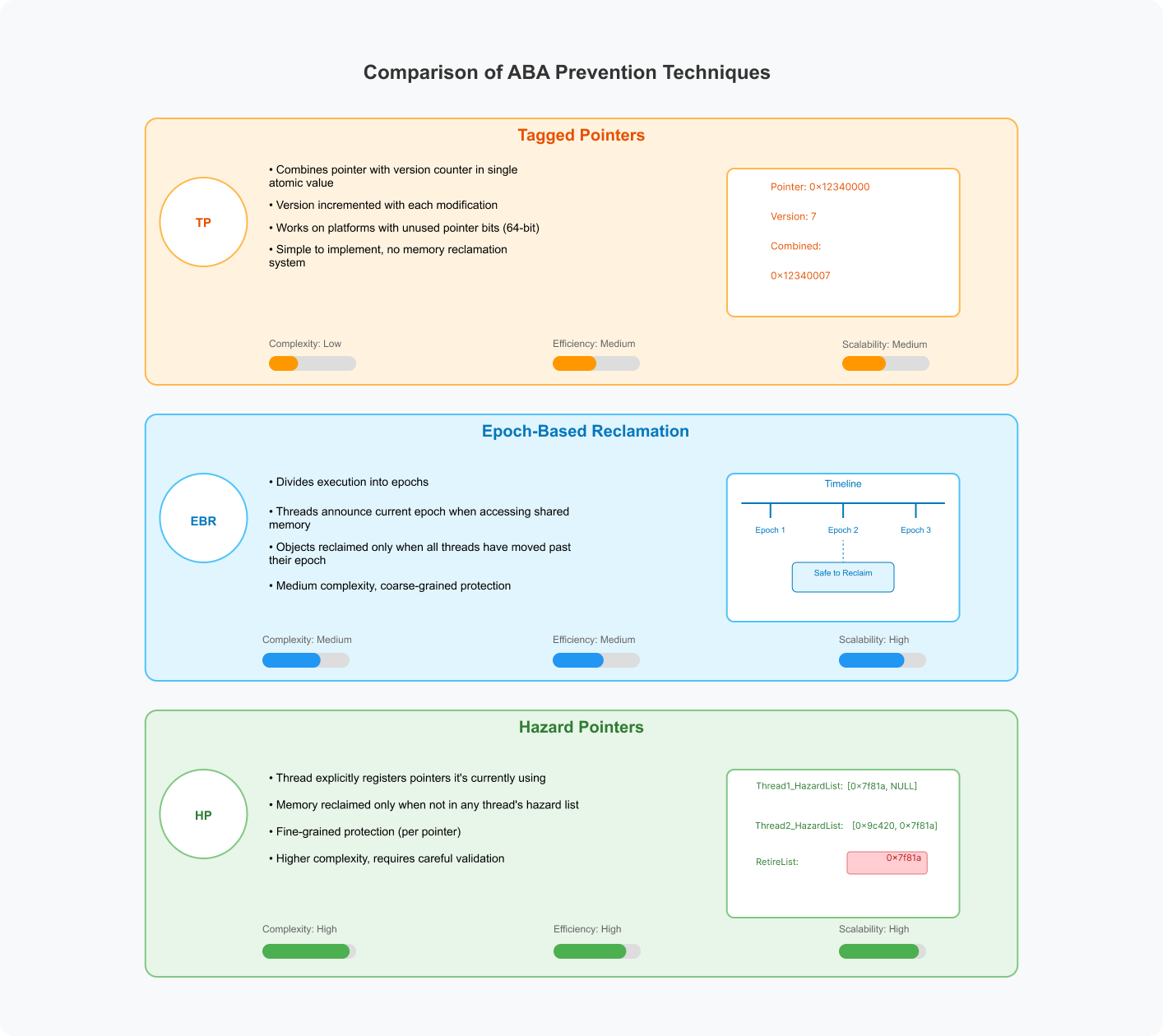
By understanding these approaches, you can choose the most appropriate technique for your specific concurrent Rust application.